Several months ago, I received a text from my GP surgery inviting me to join a clinical trial evaluating a vaccine designed to help prevent Clostridioides difficile (C. difficile or C. diff) infection in adults aged 65 and over. C. diff is a serious bowel infection that can cause severe diarrhoea, particularly in older adults and those who have recently taken antibiotics. The study is testing a vaccine intended to reduce the risk of infection.
I replied, expressing my willingness to participate. Research of this kind is essential, as the COVID pandemic made abundantly clear, and there is also a possibility that it could have some beneficial effect on my diverticulitis. Whether participants receive the vaccine or a placebo is, of course, a necessary element of any properly conducted trial, so any direct benefit to me is uncertain. Nevertheless, it is the bigger picture that matters.
Since receiving the initial invitation, I have undergone several scans, a biopsy and, ultimately, received a diagnosis of prostate cancer. Throughout this period, I consulted the doctors overseeing the trial about whether I should continue with my participation. As my cancer is classified as Gleason 6, I was advised that I could carry on as normal and remain in the study if I wished.
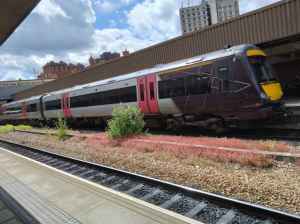 On 4th June, I caught the first of three trains to the Trialmed offices at Birmingham Research Centre, located on the University of Birmingham campus. The first train was nine minutes late, causing me to miss my connection. While waiting for the next service, I could not help noticing how scruffy and poorly maintained both the station and track appeared. I was also reminded of the overcrowding that has become commonplace on our railways, where five-carriage trains frequently devote two carriages to First Class, often with very few occupants, while Standard Class passengers are left standing due to insufficient seating. This is on one of the most expensive rail routes in the country. Appalling.
While waiting at Birmingham New Street for my final connection to University Station, I found myself bemused by the seemingly endless announcements of delayed and cancelled trains. What a way to run a railway.
The Trialmed offices were only a five-minute walk from the station, through a bustling university campus filled with students hurrying to lectures and other commitments. After signing in at reception, I completed a few forms before helping myself to a cappuccino and some ginger biscuits. Along with one other elderly participant, I sat in the waiting area watching a conveniently placed television showing Homes Under the Hammer.
Twenty minutes later, I met the doctor responsible for inducting me into the study. More forms were completed, although the process went smoothly as I had brought along details of my medical history. A blood sample was taken, I was shown how to use the thermometer provided, and the study app was downloaded onto my phone. Following this, I returned to the reception for another cappuccino and a few more biscuits.
I learned that the study was only in its second week and that researchers hope to recruit 32,000 participants worldwide. The trial will run for three and a half years. I was one of only two participants being enrolled that day.
After a further twenty-minute wait, a team of nurses administered either the vaccine or the placebo in a side room. Half an hour later, having suffered no adverse reaction, I was presented with a large and surprisingly heavy bag of equipment required for my participation in the study and then released to face the chaos that is the British railway system.
I arrived home shortly before 4 p.m., where Sue kindly collected me from Harborough station. That evening, I made my first entry in the study diary on the app: sore arm, normal temperature, no aches or pains.
 Over the following days, my temperature remained normal, but I experienced plenty of aches and pains, together with a feeling of fatigue, which suggested that perhaps I had not received the placebo.
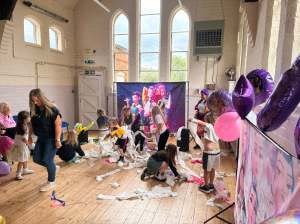
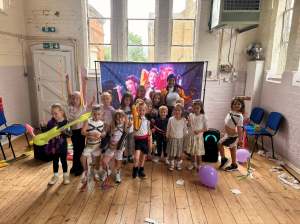
Alice celebrated her birthday on the 6th of June. Sarah had hired the church hall, conveniently located just around the corner from their home, and booked a professional K-pop entertainer to lead the party. Charlotte arrived late in the morning to collect Sue and the plants I had been looking after while Sarah and her family were on holiday, before driving to Newbold Verdon to help with the preparations. Jamie and Ruth arrived later in the afternoon.
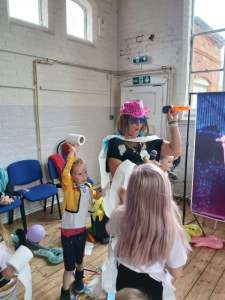

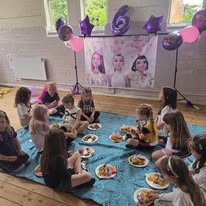 I remained at home and watched the Tigers lose a closely contested match against Bath with Sean and Jim. Judging by the photos, videos and social media posts, the party was a tremendous success: colourful, lively, full of music and packed with daft games that I was rather pleased to avoid. Charlotte, however, was not so fortunate.
On a day of sunshine interspersed with blustery showers, I came across an impressive stand of Giant Hogweed while exploring a new route during my morning off-road bike ride.
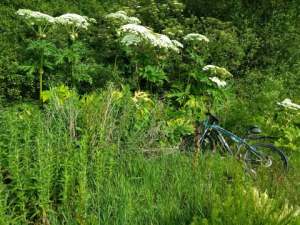 The plant is not native to the UK, originating instead from the Caucasus Mountains and Central Asia. It was introduced to Britain as an ornamental plant in the 19th century before escaping cultivation and becoming naturalised in the wild. Giant Hogweed’s sap can cause severe burns, as it contains furocoumarins that make the skin extremely sensitive to sunlight. If sap comes into contact with the skin and is then exposed to the sun, painful blistering can occur. The plants were growing quietly between a hedgerow and a field of wheat, and it was clear that they had already begun to spread. After taking a photograph, I continued with my morning exercise.
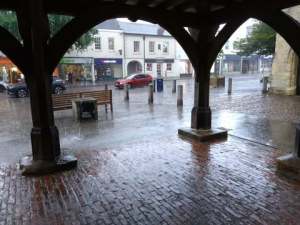 Later that morning, while Sue popped into town on her bike, I followed about half an hour later on one of my very rare shopping trips and mooched around town. I am always amazed by the number of new shops that seem to have appeared since my previous visit. I am certainly not a shopaholic; I only venture into town when I actually need something, which is not very often. I much prefer shopping online and having items delivered to the door.
As I was making my way across town, a storm suddenly struck, forcing me to seek shelter beneath the Old Grammar School. Originally built in 1614 and raised on distinctive wooden ‘legs’, the Grade I listed building now serves as a community meeting place and, on rainy days, a convenient refuge. I spent the time watching rain and hailstones lash the surrounding streets while wondering how Sue was faring on her electric bike. Thankfully, she had found a similar shelter on the opposite side of town.
That evening, Charlotte arrived to collect Sue, and together they drove to the Coach and Horses in Lubenham to attend a ‘Psychic Evening with Penny and Pete’. An unusual initiative for a village pub, perhaps, but then I suppose the availability of alcohol might help attract a few extra spirits.
For such a small village, the event was surprisingly well attended and completely sold out, with 47 souls packed into the venue. That rather demonstrates the enduring popularity of mediumship among the rural fraternity. To encourage the departed to make an appearance, the evening began with a communal sing-along of Spirit in the Sky by Norman Greenbaum.
The audience was then treated to two forty-five-minute sessions of clairvoyance from Pete and Penny. On Sue’s return to Willow Bank, the only comment she made before ascending the staircase to heaven, or at least to bed, was, “It was rubbish.”
Ah, well, life can be full of disappointments. She might have been better off staying at home and watching England beat Ukraine 3–0 with me. At least there was plenty of English spirit on show.
After a miserably damp and blustery week, Friday the 12th was, surprisingly, a relatively dry day, with spells of sunshine and only the occasional spit and spot of rain. Fortunately, it was the day I had chosen to meet up with John Lee for a ramble from the attractive Rutland village of Lyddington.
The origin of the village’s name is uncertain, perhaps meaning either “the farm or settlement of Hlyda” or “the farm or settlement by a noisy stream”. It is also the home of Lyddington Bede House, owned by English Heritage, and is a Grade I listed building incorporating parts of a medieval bishop’s palace. Sue and I visited it a couple of years ago, and it now operates as a museum. In 1547, it was seized from the Bishops of Lincoln on behalf of the Crown and later passed to Lord Burghley. Around 1600, part of the palace was converted into an almshouse, a role it continued to fulfil until 1930. Nearby are the remains of the bishop’s fishponds, although time constraints on this occasion prevented us from visiting them.
Unusually, in today’s economic climate, the village still supports two public houses: The Marquess of Exeter and The Old White Hart. It was at the former that we met in the car park at 10 a.m. I had originally booked lunch at the latter, but had to change the reservation when they informed me that a wedding reception was being held there on the same day, and they could not guarantee us a table.
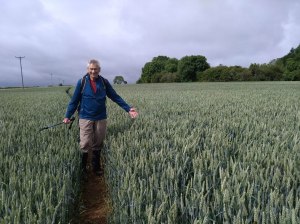 John and I had previously enjoyed this walk in October 2018, and he had since completed parts of it with a walking group from Bourne. By the end, it proved to be a demanding five-mile hike that tested both ankles and knees, leaving us rather weary when we finally returned for lunch.
The first section of the walk, towards the tiny hamlet of Stoke Dry, was easy going. Much of the conversation revolved around the evening’s forthcoming clash between Leicester Tigers and Northampton Saints. Stoke Dry derives its name from the Old English for an “outlying farm or settlement” and stands on a hill overlooking a valley that may once have been marshy.
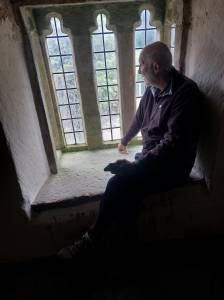
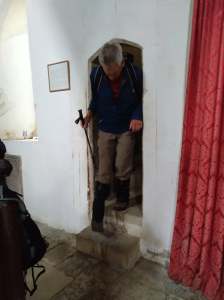
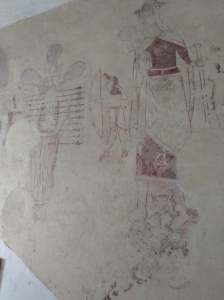 St Andrew’s Church contains medieval wall paintings and a fine Romanesque chancel arch. Local legend claims that the Gunpowder Plot conspirators met in a small room above the porch, although the only real basis for the story is that the manor formed part of the estate of Sir Everard Digby. Having visited the church in 2018, we once again lingered to photograph the wall paintings and climb the narrow turret staircase to the supposed Gunpowder Plot room. John, however, suggested a more plausible explanation: that it had served as a Room of Attirement, where the priest changed vestments between services.
Continuing on our way, the path followed part of the north-eastern shore of Eyebrook Reservoir, although not close enough for us to dip our toes in the water. Before reaching the A6003, we crossed a field completely devoid of grass, which plastered the soles of our boots with thick, claggy mud and marked the beginning of the gruelling final section of the walk.
There was some relief along a short stretch of tarmac road, where we managed to scrape off the worst of the ankle-straining clag against a conveniently positioned road drain. It was there that I spotted a discarded car registration plate and promptly stuffed it into my rucksack, for no apparent reason other than the influence of the Yorkshire squirrel still lurking within me.
Leaving the road behind, we plunged back into a landscape of ridge-and-furrow pasture. The final mile and a half proved both unpleasant and tiring. A very wet winter, combined with fields that had recently housed herds of cattle, had transformed the ground into a veritable minefield of ankle-twisting hazards. Our route across the last field was made even more difficult by the need to detour around a huge bull, which was thankfully far more interested in sniffing one member of his harem than charging us for trespassing across his territory.
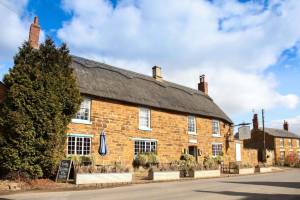 We reached the far end of Lyddington, some distance from The Marquess of Exeter, with considerable relief. The Marquess of Exeter, a Grade II listed inn, occupies the site of a tavern thought to have existed since parish records began in 1563. Built of local red limestone, the building is beautifully preserved. Inside, a series of small interconnecting rooms feature low ceilings supported by timber beams, inglenook fireplaces and gleaming flagstone floors. It also operates as a restaurant and hotel.
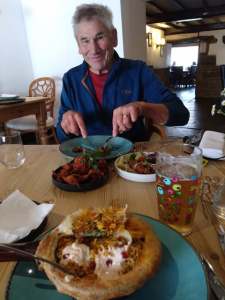 Having previously researched the establishment and discovered that the chef was Indian and enjoyed an excellent reputation, it seemed only right to order a chicken balti rather than my usual pie. After a lengthy wait, and much to my amusement, the balti arrived in a shallow metal pan topped with a naan bread lid, accompanied by a small bowl of very sweet raita. It was certainly quirky, but also very tasty. In a sense, I suppose I still got my customary pie, albeit one with a metal base.
While I was walking in Rutland with John, Sue had planned a cycle ride with Viv, also ending with lunch. However, despite the favourable forecast, Viv had been influenced by the dreadful weather of the preceding days and persuaded Sue to abandon the ride. Instead, they met at a café in town and spent most of the morning and afternoon putting the world to rights over coffee and lunch.
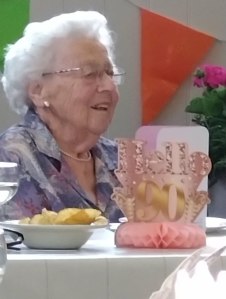
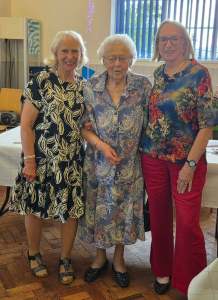 Mid-morning on the 13th, Sue drove to Tenbury Wells to meet up with her sister, Philippa, who had travelled up from Buckfastleigh the previous day and stayed overnight at the Fountain Inn. They were attending the 90th birthday party of family friend Sheila Palmer and planned to stay with her that night following the celebrations. Pip had arrived a day early to meet up with an old school friend.
The party was held in the nearby village of Rochford and was attended by 28 guests. Pip drove Sue and Sheila to the venue, arriving in time to welcome guests alongside the organisers, friends Lynne and Jane, at 4 p.m. Following speeches, food and plenty of conversation, the celebrations eventually drew to a close at around 8 p.m.
 On her return to Willow Bank the following day, Sue reported that Sheila was sadly beginning to look quite frail. She was also suffering from anxiety, for which she was taking medication, and now received help at home with cleaning and other household tasks.
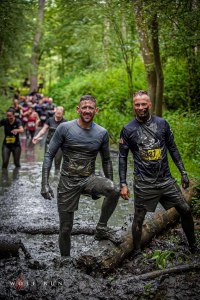
 The following day, Jamie and his friend Tommy took part in The Wolf Run at the nearby Stanford Hall Estate in Leicestershire, raising money for Prostate Cancer Research. From the photographs Jamie later posted on the family Messenger group, it looked as though they had a fantastic time. Covered from head to toe in mud and tackling a variety of challenging obstacles, they certainly appeared to embrace the spirit of the event and enjoy every minute of it.


Leave a Reply